
A multicenter phase III study using HLA-unmatched allogeneic placenta-derived stromal cells (PLX-PAD) for the treatment of severe critical limb ischemia accompanied by mechanistic studies

Project objectives
PACE aims for advancing clinical application of the “off-the-shelf” allogeneic placenta-derived stromal cell product (PLX-PAD) for critical limb ischemia (CLI), a clinical indication with high unmet medical need, by performing a clinical phase III trial integrated with mechanism-based studies.
PLX PAD cells were accepted into the very recently defined European Medicines Agency (EMA) “Adaptive Pathways to Patients” pilot project for Advanced Therapy Medicinal Products (ATMPs).
This pilot project encourages timely access for patients to new therapies and is designed to accelerate the time to clinic for therapies considered by the EMA to be particularly needed by the European community. “Adaptive pathways” is a scientific concept for medicine development and data generation which allows for early and progressive patient access to a new medicine and applies primarily to treatments in areas of high unmet medical need where it is difficult to collect data via traditional routes (www.ema.europe.eu).
The PACE specific objectives are:
- Confirm the robustness of the manufacturing process for generating PLacenta-eXpanded stromal cells optimized to support regeneration in CLI, the severest form of Peripheral Arterial Disease, by in depth characterization of the PLX-PAD product batches.
- To evaluate the efficacy, tolerability and safety of local intramuscular (IM) injections of HLA-unmatched allogeneic PLX-PAD for the treatment of patients with CLI with minor tissue loss who are unsuitable for revascularization in a randomized, double-blind, multicentre, placebo-controlled, phase III study.
- To present a model for the clinical development of a cell product using the new “Adaptive Pathways to Patients” approach defined by the EMA.
- To look beyond the traditional clinical trial endpoints of safety and efficacy, actively investigating the mechanisms of action of PLX-PAD therapy, exploring biomarkers in order to understanding response/non-response in particular patients (stratification and therapy response markers to understand whether PLX-PAD therapy has a comparable outcome in female and male patients, particularly in view of the biased male/female ratio of 3:1 in CLI patients) and to reveal the impact of the major risk factor, type2 diabetes (T2D), on the response to therapy.
To disseminate our results for advancing clinical application of ATMPs for indications with high unmet medical need by performing a high quality clinical trial with emerging therapeutics integrated with mechanism-based research.
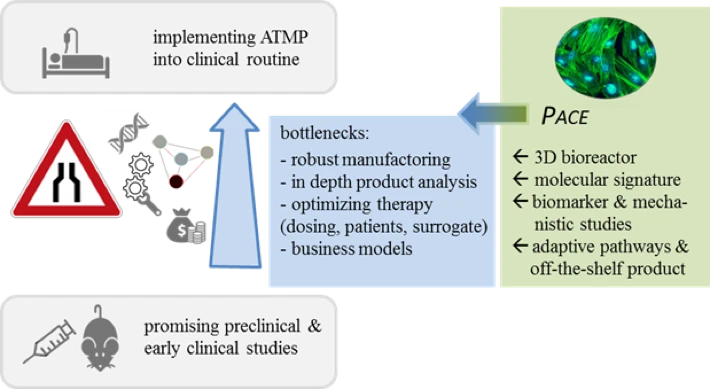
PACE targets key bottlenecks on the roadmap to implementing cell therapy into routine